
- September 09
- By: SB Pile Foundation
Types of Pile equipments
Types of Pile Driving Equipments
- Piling rigs
- Piling winches
- Hanging leader
- Hammer guides
- Piling hammer
- Helmet, driving cap, dolly, and packing
Piling Rigs
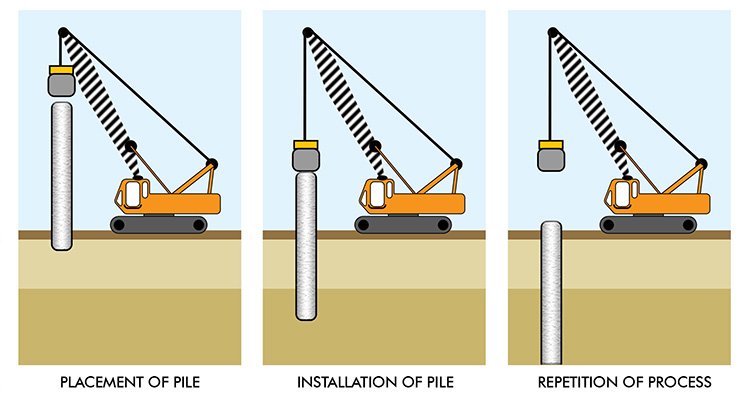
It composed of a series of leaders, which are consist of tabular element or hard box, placed and fixed on a crane base as it can be seen from Figure-3.Not only does the leaders support the hammer and the pile but also guide them when the pile is forced into the ground.
Piling Winches
The prime goal of piling winches is to left the hammer and piles in addition to support tools that responsible for leader raking and rotation. It functions with pile frames and different powering sources such as hydraulic power, stream; diesel; or petrol engines, and occasionally electric motors could be applied for powering winches. There are different piling winches with different capacity for instance winches with double or triple drums possess satisfactory controlling and pile driving speed whereas one drum winch does not have that advantage. So, the former type would be favored provided that handing and driving piles with great speed is required.
Hanging Leader
Hanging leaders are specifically designed to be hanged from the jib of a crane as shown in Figure-9. A steel strut, which its length can be varied as per requirements of construction site, provides a stiff connection from the leader foot to the machine bed frame.
Hammer Guides
When it is intended to remove hanging leaders or piling frames completely, rope suspended leaders which are commonly guided by timber or steel formwork, would be considered. In this technique, an independent crane needed to control the pile and establishing the guide and hammer. it is necessary to set and secure the guide properly in order to avoid movements specifically in the during raking pile installation. This is because serious fatigue stress would generate if the thrust is not centered properly and the guide might deteriorate. Finally, it is required to prevent disproportionate bending stress development in guide and piles because it leads to undesired results. for example, when heavy hammer is attached to the upper end of a long pile which is driven at flat angle of rake, excessive bending stress may be generated at support point in the guide. This problem might be tackled by providing suitable support for the pile at proper position.
Piling Hammer
There are several factors that greatly influence the decision to choose suitable piling hammer. For example, pile size and weight, the resistance of the ground which should be overcame in order to obtain specified penetration, construction site space availability, noise limitation that might be imposed at certain areas, and availability of cranes. Previously, the combination of a dynamic equation result and extensive experiences were employed to select piling hammer, but this has changed nowadays and drivability analysis results, which is conducted using computer program based on Smith wave equation, is considered for the piling hammer determination. As for input data required for drivability analysis, piling hammer producer provided necessary data about efficiency and energy feature of the piling hammer. It should be bore in mind that piling hammer efficiency is not a constant and it is affected by number of factor for example mechanical condition of the hammer and operation temperature. It should be known that the mechanical condition is not influence the efficiency of piling drop hammer.
Helmet, Driving Cap, Dolly and Packing
Helmet is a cast steel that placed over the pile to hold the dolly that placed between the pile and the hammer to avoid pile head deterioration that may cause by pile driving hammer. Dolly, which is square at the bottom and round at the top, is placed in a square recess at the top of the helmet. There are different types of dollies for example Elm dollies, hardwood like oak; greenheart and pyinkado, and their selection is dependent on the driving force. As far as packing is concerned, it is placed between pile top and the helmet in order to protect the former from the hammer blow. Different types of packing include paper sacking, thin timber sheet, coconut mapping, and sawdust in bags. Regarding driving cap, it is provided as a protection for steel bearing piles. It is necessary to place the driving cap tightly otherwise the pile cap would suffer deterioration. That is why it is fitted with a recess for hardwood or plastic dolly and with steel wedges to fix the cap tightly on its position. Lastly, serious pile head damage and hammer breakage cannot be avoided unless appropriate material and suitable thickness is selected for dollies and packing.